
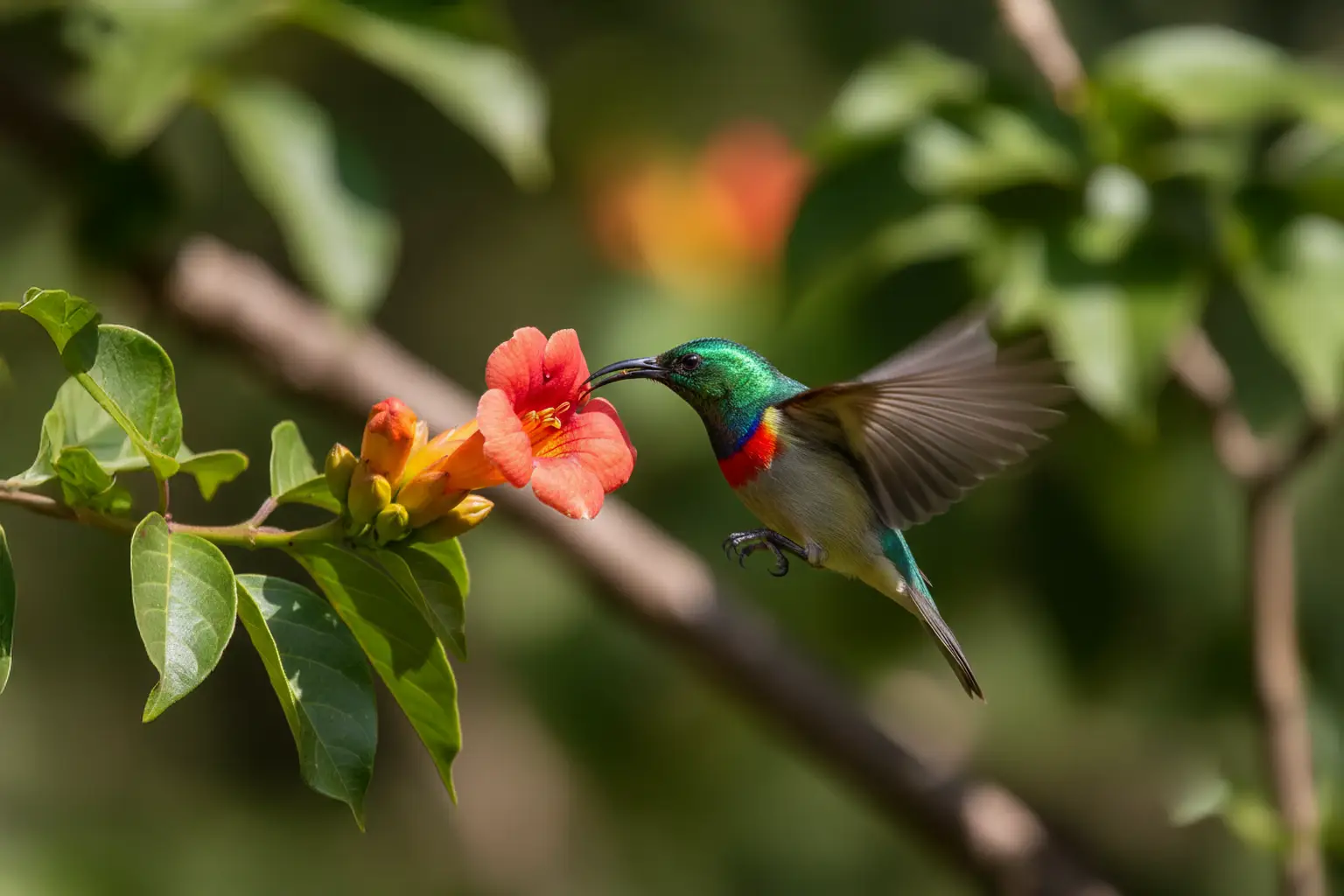

The Honde Valley, draped along the steep eastern slopes of Zimbabwe’s Eastern Highlands, is renowned for its mist-bound forest corridors, lush river systems, and humid pockets of evergreen vegetation. While many visitors arrive in search of sweeping scenery or cool mountain air, the valley’s most captivating secrets often sit above eye level —flitting through the flowers and foliage of its mature woodland, gardens, and montane scrub.
This vibrant world is home to a remarkable collection of nectar-feeding and sunbird species, each playing a vital ecological role while adding to the valley’s unique sense of place. Unlike the endemics of the deeper forest understorey, these species are dynamic and vocal. Their movements animate the treetops and flowering bushes: sunbirds hovering to feed at tubular blossoms, sugarbirds chasing rivals over Protea stands, and colourful males displaying their iridescent plumage.
These birds not only enrich local biodiversity but also shape the ecosystem, acting as key pollinators and sustaining ecological balance. For travelers exploring the Honde Valley, this group offers an exciting encounter with the region’s upper-layer ecosystems. Their presence highlights the valley’s strong conservation value, as many species rely on stable woodland, flowering plants, and undisturbed cover. The following profiles introduce each species in this group, offering an understanding of their characteristics and their place within the larger valley landscape.
Variable Sunbird
Scientific Name: Cinnyris venustus The Variable Sunbird is a widespread species, often seen in gardens, open woodland, and near flowering aloes. The male is small, roughly 10 cm in length, and is characterized by a glossy green head and nape, a maroon breast band, and a yellow or orange belly. It is known for its highly energetic and acrobatic flight while foraging for nectar. This common resident is classified as Least Concern.
Eastern Miombo Sunbird
Scientific Name: Cinnyris manoensis Associated closely with the Miombo Woodland on the slopes, this sunbird was formerly known as the Miombo Double-collared Sunbird. The male displays iridescent green and blue, contrasted by a rich, striking reddish throat. It is intricately linked with the Miombo woodland, which provides the sustenance and shelter necessary for its survival. BirdLife International has assessed this species as Least Concern.
Purple-banded Sunbird
Scientific Name: Cinnyris bifasciatus Found in the scattered trees, woodland fragments, and along the forest edge, the male Purple-banded Sunbird is easily identified by the namesake purple band across its chest. It is an active and acrobatic species, often congregating around abundant flowering sources and aggressively defending its territory. The population is stable and categorized as Least Concern.
Scarlet-chested Sunbird
Scientific Name: Chalcomitra senegalensis Mentioned as a common and regular resident, the male is unmistakable with its vivid scarlet breast, set against an iridescent emerald green crown and chin. It is often found along the forest fringe, in more wooded areas, and is a frequent visitor to woodlands and gardens. This widespread and adaptable species is classified as Least Concern.
Malachite Sunbird
Scientific Name: Nectarinia famosa This is one of the larger sunbirds, with the breeding male measuring up to 25 cm long due to its notably long central tail feathers. The male is a brilliant, uniform metallic green and is frequently seen around rocky ridges and Protea bushes, especially at slightly higher elevations. A common resident, it is classified as Least Concern.
Bronze Sunbird
Scientific Name: Nectarinia kilimensis Found in similar habitats to the Malachite Sunbird, particularly higher up on rocky ridges and open scrub, the male Bronze Sunbird showcases striking metallic bronze plumage that often appears black in low light. It possesses a long, thin, well-curved bill, perfectly adapted for extracting nectar. This species is not considered threatened and is listed as Least Concern.
White-bellied Sunbird
Scientific Name: Cinnyris talatala Also known as the Yellow-bellied Sunbird, this species is found in more open woodland habitats and dry Acacia savanna. The male displays an iridescent throat and back, separated from a distinct white belly by a metallic purple line. It is a common to locally abundant species, classified as Least Concern.
Gurney’s Sugarbird (Kin)
Scientific Name: Promerops gurneyi While not a true sunbird, this large, medium-sized passerine is often grouped with them due to its nectar diet and appearance. It is a significant species in the Eastern Highlands, typically found on rocky ridges with Protea bushes and Philippia scrub at higher elevations surrounding the valley. The bird is recognizable by its long, decurved bill, a chestnut-coloured forehead, and a conspicuous bright yellow rump. Unlike the sunbirds, this species is classified as Near Threatened due to its specific dependence on the Protea ecosystem.
Experiencing the Nectar-Feeders of the Honde Valley
Exploring the sunbirds and sugarbirds of the Honde Valley offers a refreshing contrast to the more elusive forest-floor specialists. Early morning walks along woodland edges, or slow exploration near flowering aloes and Protea bushes, reward travelers with a lively blend of calls, colour, and movement. The best time to see most sunbirds is during the warmer months (November to April), especially when the vegetation is lush and flowers are abundant, which brings the birds out to feed.
This group highlights not only the ecological richness of the valley but also the importance of maintaining flowering habitat connectivity across slopes and watersheds. By appreciating these avian jewels, visitors gain a fuller picture of the valley’s ecological story—a thriving world where flowers, insects, and birds are tightly interlinked. As tourism grows, responsible travel and habitat conservation remain essential in ensuring that these species continue to shape the character of the Honde Valley for generations to come.