
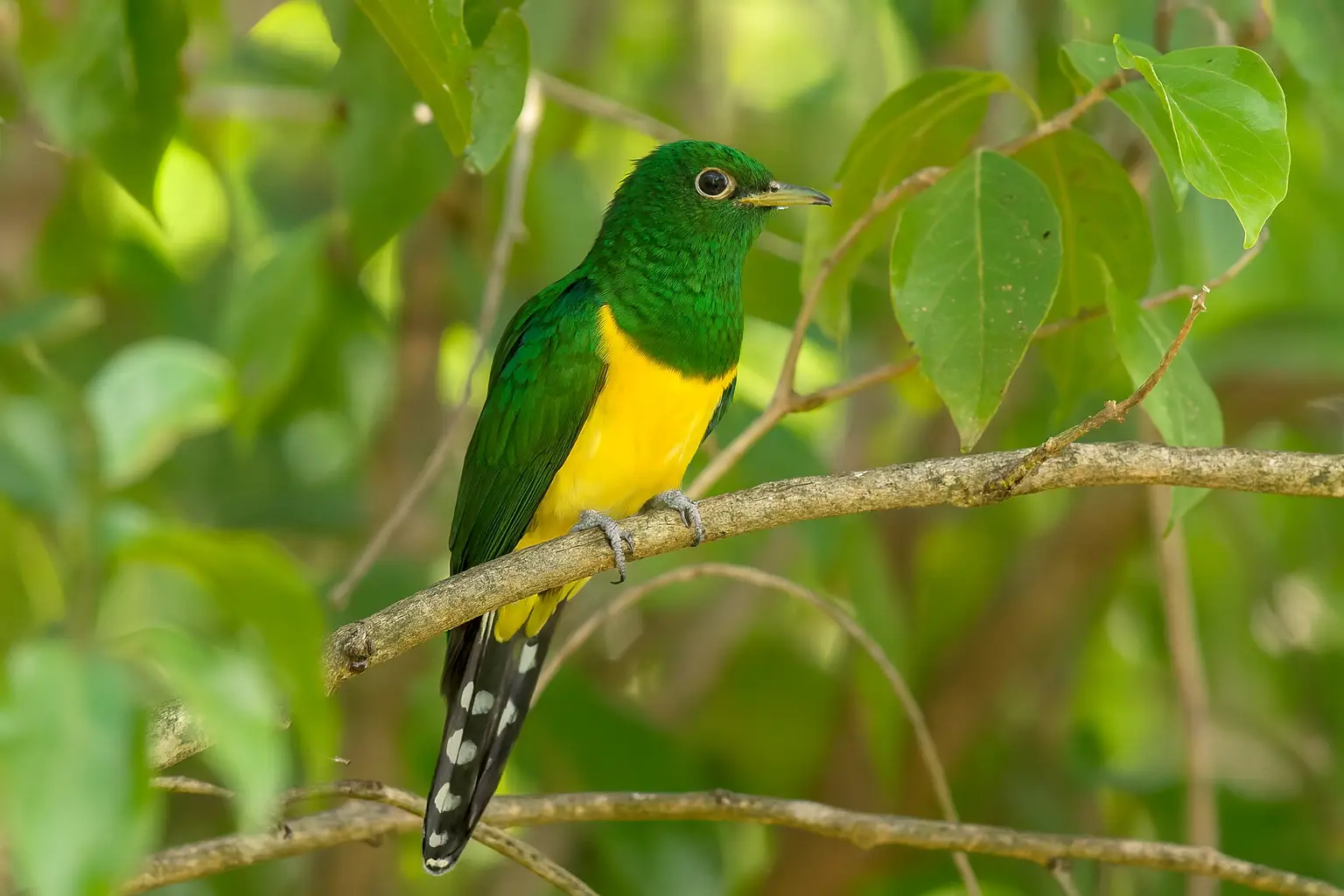

The Honde Valley’s mosaic of low-altitude forest, riverine thickets, and mixed woodlands creates an ideal refuge for a remarkable group of birds known for their haunting calls and seasonal appearances—the cuckoos and coucals. These species, some resident and some migratory, form an essential thread in the valley’s ecological story. Their presence is closely tied to healthy forest edges, shaded gullies, and the insect-rich habitats created by a warm and humid climate.
For birders, hearing the first calls of a cuckoo drifting across the valley often signals seasonal change. Exploring forest trails, woodland margins, and quiet, overgrown riverbanks offers rewarding opportunities to encounter these elusive, charismatic birds.
Barred Long-tailed Cuckoo — Cercococcyx montanus
A sought-after species in the Eastern Highlands, the Barred Long-tailed Cuckoo prefers dense, shaded forest where it moves quietly through the canopy. In the Honde Valley it is best encountered from February to March, when its presence becomes more noticeable in low- and mid-altitude forest patches.
Status: Not Endangered
Lesser Cuckoo — Cuculus poliocephalus
A summer visitor, the Lesser Cuckoo arrives with warm-season migrants and is prized for its association with intact forest ecosystems. Its presence adds a subtle but meaningful layer to the Honde Valley’s seasonal birdlife.
Status: Not Endangered
African Emerald Cuckoo — Chrysococcyx cupreus
A brilliant flash of metallic green often gives away this forest jewel. The African Emerald Cuckoo inhabits wooded edges and mixed forest habitats throughout the valley. Its descending whistle is one of the most iconic sounds of the Eastern Highlands.
Status: Not Endangered
Diderick Cuckoo — Chrysococcyx caprius
Common across much of Africa, the Diderick Cuckoo thrives in open woodland and cultivated areas. In Honde Valley it is often heard before it is seen, its bright, ringing call carrying across farmlands and forest margins.
Status: Not Endangered
Klaas’s Cuckoo — Chrysococcyx klaas
A delicate green-and-white species associated with forest edges, Klaas’s Cuckoo is a familiar voice in the valley’s woodlands. Its clear two-note call is a distinctive feature of the region’s soundscape.
Status: Not Endangered
Red-chested Cuckoo — Cuculus solitarius
Known widely as the “Piet-my-vrou,” this species is heard far more often than seen. In the Honde Valley it inhabits woodland, riverine forest, and well-vegetated valleys, adding a nostalgic soundtrack to the landscape.
Status: Not Endangered
Black Cuckoo — Cuculus clamosus
Recognisable by its mournful, far-carrying call, the Black Cuckoo occupies well-wooded areas and thickets. Its preference for dense habitat often keeps it concealed high in the canopy.
Status: Not Endangered
Common Cuckoo — Cuculus canorus
A globally widespread migrant, the Common Cuckoo occasionally finds its way into southern Africa. Its presence in the Honde Valley adds an intriguing migratory element to the local bird community.
Status: Not Endangered
Jacobin Cuckoo — Clamator jacobinus
Often associated with storms and seasonal shifts, the Jacobin Cuckoo is a distinctive species with bold black-and-white plumage. It frequents open woodland, agricultural areas, and forest edges around the valley.
Status: Not Endangered
Levaillant’s Cuckoo — Clamator levaillantii
This lively cuckoo favours bushy woodland and well-vegetated riverine corridors. Its energetic behaviour and striking plumage make it one of the more conspicuous cuckoos in the region.
Status: Not Endangered
Coucal Species of the Valley
Senegal Coucal — Centropus senegalensis
A bird of open woodland and thick undergrowth, the Senegal Coucal is often seen moving methodically through shrubs or calling from exposed perches at dawn.
Status: Not Endangered
Burchell’s Coucal — Centropus burchellii
Preferring dense grass, reeds, and moist thickets, Burchell’s Coucal adds a rich, bubbling call to wetland edges and riverine forests.
Status: Not Endangered
Black Coucal — Centropus grillii
A highly seasonal species, the Black Coucal appears in marshy grasslands during periods of good rainfall. In the Honde Valley, it is tied to wet, grassy habitats and may be locally uncommon where wetlands shrink.
Status: Not Endangered (but locally sensitive to habitat loss)
The Forest Voices of Honde Valley
Together, the cuckoos and coucals of the Honde Valley create a tapestry of sound and seasonal movement that enriches every corner of the landscape. From dense lowland forest to open woodland and wetland edges, these birds reflect both the richness and the fragility of the valley’s ecosystems. Their continued presence underscores the importance of conserving forest cover, river corridors, and wetlands to protect the acoustic and ecological character of this unique region.